
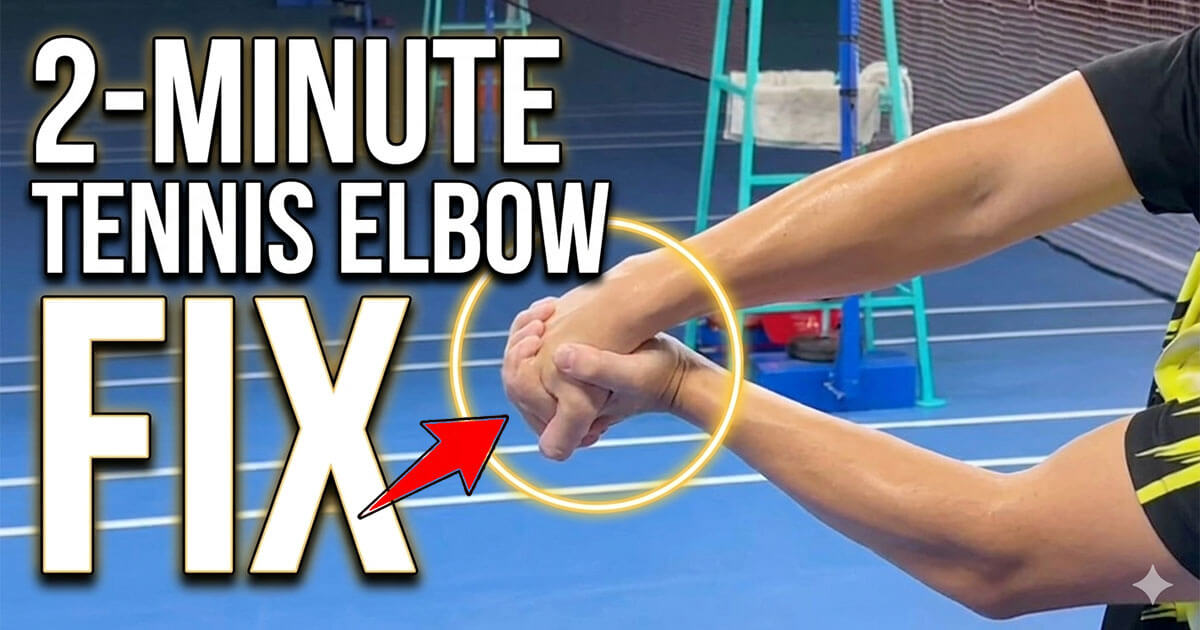
If you’re looking for how to fix tennis elbow without expensive treatments or weeks off the court — I’ve been there. Let me be upfront about two things.
First: I’m not a doctor, a physical therapist, or a tennis coach. I’m a 47-year-old guy who plays five mornings a week and refuses to stop — even when my body has other opinions.
Second: when tennis elbow hit my right arm, I did almost everything wrong. I skipped rest. I kept playing. I rubbed hot oil on it like my elbow was a sore muscle from the 1990s. It didn’t work.
What eventually worked was embarrassingly simple — two stretching moves I found on YouTube from a badminton player, a racket swap, and a few accidental rest days thanks to rain and a cleared weekend schedule. No brace. No medication. No doctor visits.
I’m sharing this not because my way is the right way — honestly, you should probably rest more than I did. I’m sharing it because it worked for a stubborn, court-addicted player who couldn’t bring himself to sit out, and maybe that sounds familiar.
And if you found this post while searching for answers at 11pm with an aching elbow — well. Sometimes the right information finds you at exactly the right time. This might be one of those times.
If it does — keep reading.
How It Started: Two Mistakes That Caused My Tennis Elbow
Looking back, I can pinpoint exactly when it went wrong. Two mistakes, one week apart.
Mistake #1: The wrong string job.
I play with a Head racket — 295 grams, solid, comfortable. Nothing wrong with it. But one day I brought it in for a restring, and the stringer put in a stiff, high-tension string. The kind he uses for his 16-year-old son — a semi-professional junior player with a 16-year-old arm.
I have a 47-year-old arm. That distinction matters more than I realized.
He did ask me beforehand — “You want this string?” And I said yes without hesitation. I think part of me liked the idea of playing with the same setup as a serious junior player. More tension, more power, right? Turns out the only thing it gave me more of was pain. Within days, I felt it — a sharp, nagging pain right at the top of my right elbow, exactly where the tendon attaches to the bone.
A quick note here: if you’re a recreational player, be careful with string changes. That new string everyone’s talking about at the club? It might be great for someone else’s game and terrible for your elbow. String tension and stiffness affect how much vibration travels up your arm on every single shot. It adds up fast.
Mistake #2: I skipped the warm-up. Again.
Sound familiar? You show up at the court, your buddies are already rallying, and somehow the 10-minute warm-up routine just… doesn’t happen. You tell yourself you’ll loosen up during play.
My old coach told me something years ago that I keep forgetting at the worst possible times: “If others want to play right away, let them. You warm up properly first. If they want to start without you, let them.”
I forgot that advice. I walked onto the court, skipped the warm-up, and went straight into full swings on a cold arm.
Two mistakes. One elbow. Classic.
What I Tried First to Treat Tennis Elbow (And What Didn’t Work)
My first instinct? Hot oil.
I had a bottle of Thai muscle rub sitting at home — the kind that smells like it’s working even when it isn’t. I massaged it into my elbow after every session, convinced I was doing something useful. Spoiler: I wasn’t.
A few days later I went down the internet rabbit hole and found out that heat and massage are actually the wrong call for tennis elbow, especially in the early stages. What you want is rest and ice — not warmth. The hot oil wasn’t healing anything. If anything, it was making the inflammation worse.
So I had two options: rest properly, or keep playing and figure something else out.
You can probably guess which one I picked.
Here’s the thing about being a court-addicted recreational player — the idea of sitting out feels worse than the pain itself. Does that sound irrational? Absolutely. Did I do it anyway? Every single morning.
I kept showing up. I kept swinging. I kept telling myself it would sort itself out.
It didn’t.
But somewhere between the denial and the stubbornness, I stumbled onto something that actually helped. And it came from the last place I expected — a YouTube video from a badminton player who’d been through something far worse than what I had.
More on that in the next section.
How to Fix Tennis Elbow: Two Stretches, Two Minutes a Day
I found him while scrolling through YouTube late one night, elbow aching, looking for anything that wasn’t “rest for 6 weeks.”
His name is Nguyễn Duy — a Vietnamese badminton player, not a doctor, not a physical therapist, not someone selling a $97 recovery program. Just a guy who’d been through lateral epicondylitis so bad he couldn’t lift a cup of water. Couldn’t hold a bowl of rice. Pain running from his elbow all the way up to his shoulder, every single day.
He tried doctors. He tried medication. The meds killed his stomach and the pain stayed.
Then he figured out two simple stretches. Within days, the pain was gone.
I watched the video three times. Then I tried it. Then I kept doing it every day — morning and afternoon, two minutes total — and slowly, stubbornly, my elbow started to come around.
Here’s exactly what he showed:
Move 1 — Wrist Flexor Stretch
Extend your right arm straight out in front of you, parallel to the ground, palm facing up. Use your left hand to gently pull your right hand downward — bending the wrist toward the floor. You’ll feel a stretch along the top of your forearm, right where the tendon sits.
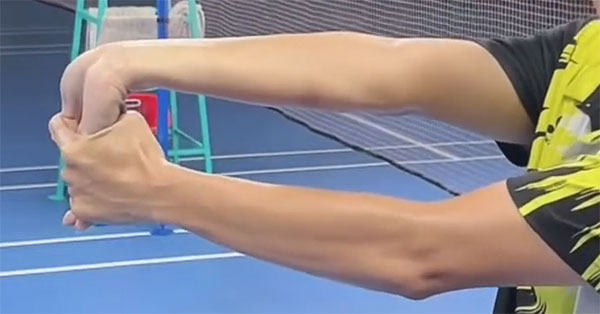
Hold for 20 seconds. Release. Repeat 3 times.
You’ll feel a mild, sharp sensation at the tendon attachment point. That’s normal — that’s exactly where you want to feel it. Don’t push past pain, but don’t back off the moment it gets uncomfortable either. Find the edge and hold it.
Move 2 — Wrist Extensor Stretch
Same starting position — arm extended, straight out. This time, rotate your wrist outward and downward, so your palm faces away from you and your fingers point toward the floor. Use your left hand to gently push the back of your right hand further into the stretch.
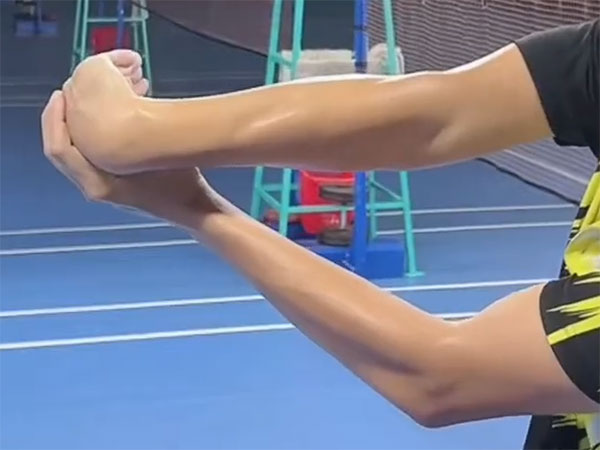
Hold for 20 seconds. Release. Repeat 3 times.
That’s it. Two moves. About two minutes. Morning and afternoon.
Do them at your desk. Do them waiting for your coffee. Do them on the sideline while your friends are warming up — which, as we’ve established, you should actually be doing anyway.
I’m not a medical professional and I can’t promise this works for every type of elbow pain — different injuries respond differently. But for lateral epicondylitis, the kind that hits the top of the elbow from racket sports? This is the simplest, most effective thing I found. No equipment. No cost. No side effects.
Nguyễn Duy’s original video is right here if you want to see the exact movement demonstrated:
Bonus move: A simple one I added on my own — make a tight fist, then extend your arm straight out in front of you and hold the stretch for a few seconds. Release and repeat. You can do this anywhere, anytime, without anyone thinking you’re doing physical therapy in public. Well, mostly.
The Racket Swap That Helped My Tennis Elbow Recovery
While the stretches were helping, I knew I needed to address the root cause — not just manage the symptoms.
The string was the problem. And so was the racket.
A friend of mine had a spare Wilson sitting in his bag — 225 grams, power-assisted, strung with soft nylon. The complete opposite of what I’d been playing with. I asked if I could borrow it. He said sure. I figured I’d try it for a week.
That week was humbling.
If you’ve ever switched from a heavier control racket to a lighter power racket with softer strings, you know what happens. Every shot you’ve calibrated for weeks suddenly flies long. Balls you’d normally place comfortably inside the baseline start sailing out. You second-guess your swing. You lose points you shouldn’t lose. You might even lose to players you’d normally beat without much trouble.
Sound familiar? Or is that just me?
Here’s what I’d tell anyone going through the same adjustment: accept it. Embrace the losing week. Don’t fight it.
Because something interesting happens when your shots keep flying out — you start paying more attention. You slow down. You focus on contact point, on swing path, on timing. You stop muscling the ball and start actually hitting it. The lighter racket and softer strings force you to be more deliberate, more controlled, more precise.
One to two weeks later, you’re not just back to your previous level — you’re playing slightly better, because you’ve been forced to clean up your technique.
One humbling week in exchange for cleaner strokes and a healthier elbow. Not a bad trade.
Changing your equipment is one part of the puzzle. The other part is changing how you play while you recover — here’s the full breakdown.
A word about strings — because this matters more than most players realize.
Recreational players tend to underestimate how much string choice affects the arm. We see a string getting buzz at the club, or a hitting partner raving about their new setup, and we want to try it.
Be careful with that impulse.
What works for a 16-year-old training five days a week with professional guidance is not necessarily what works for a 47-year-old playing five mornings a week for the love of the game. Stiffer strings transfer more vibration to your arm on every single shot. Over hundreds of shots per session, that adds up to a lot of stress on tendons that aren’t 16 anymore.
When in doubt — go softer, go lighter. Your elbow will thank you before your ego does.
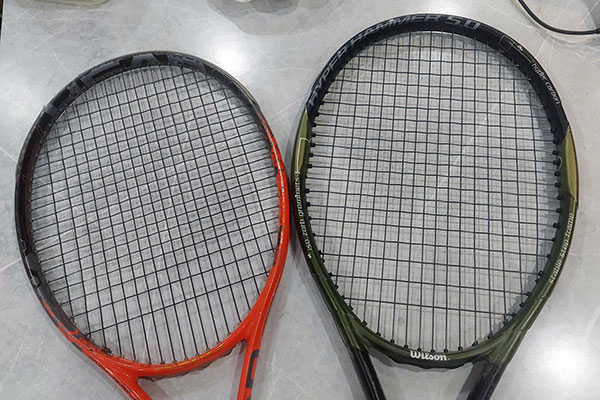
One more detail worth mentioning: the Head was strung with a twisted, textured string — the stiff kind that grips the ball hard. The Wilson came with smooth, soft nylon. That difference alone likely accounts for as much of my recovery as the weight change did.
The Towel Exercise for Tennis Elbow (And a Bad Joke About Laundry)
While I was going down the recovery rabbit hole, I came across another exercise that’s worth adding to your routine — this one from Quang Duong, a Vietnamese-American professional pickleball player who shared it in a short video online.
The move is simple: grab a towel with both hands and wring it. Like you’re squeezing water out of a wet shirt — twist it one direction, then the other. Slow and controlled, not aggressive. That wringing motion engages exactly the muscles and tendons involved in tennis elbow, strengthening them through the full range of motion.
It sounds almost too simple. But simple is good. Simple is what you actually do every day.
Now, if your situation at home involves a spouse who regularly assigns you laundry duty — I have good news. Stop using the washing machine for the wringing part. Do it by hand. You’re not doing chores. You’re doing physical therapy. Two birds, one stone. You’re welcome.
In all seriousness though — you don’t need to wait until laundry day. That sweat towel sitting in your tennis bag right now? That’s your equipment. Wring it out after your session. Wring it during the water break between sets. The exercise works anywhere, anytime, with something you already have in your hand on the court.
Here’s Quang Duong demonstrating the exact movement:
The Warm-Up Routine That Prevents Tennis Elbow (But You Probably Skip)
Let me confess something.
My coach told me years ago — before I ever had an elbow problem — exactly how to start every session. He was clear about it. Specific. And I followed it faithfully for a while.
Then life got in the way. Friends were already on the court. The competitive itch kicked in. And the warm-up slowly became optional. Then rare. Then basically nonexistent.
Sound familiar? Be honest.
Here’s what a proper warm-up actually looks like — the one I should have been doing all along, and the one I now refuse to skip:
Step 1 — Shadow Swings (No Ball)
Go through each stroke without a ball. Forehand, backhand, volley, smash — 10 reps each. That’s one round. Do three rounds.
Thirty forehands. Thirty backhands. Thirty volleys. Thirty smashes. Full motion, controlled pace, no rushing.
This isn’t just about loosening up your arm — it’s about waking up your footwork, your rotation, your muscle memory. Everything that makes your strokes work properly when the ball actually arrives.
Step 2 — Short Court Rally
Find a partner and rally softly inside the service boxes — the small court area near the net. Keep it gentle, keep it controlled, no pace. About five minutes.
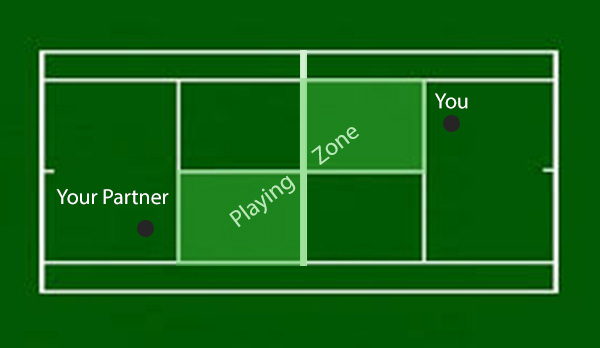
This bridges the gap between shadow swings and full play. You’re introducing the ball, calibrating your timing, letting your body adjust to real contact without demanding full effort yet.
A lot of players skip this part — or rush through it like it’s a formality. Don’t. Short court rallying is where you actually learn to control the ball. Placement, touch, soft hands. Some players who look great hitting full-pace groundstrokes from the baseline completely fall apart the moment you ask them to play a delicate exchange up at the net. The small court doesn’t lie. If you can’t control the ball from ten feet away, pace is just covering up a technique problem. Spend the five minutes. It pays off more than you’d expect.
Step 3 — Full Court, Easy Pace
Gradually move back toward the baseline. Rally the full length of the court, still at maybe 50-60% pace. Let the intensity build naturally over another five minutes before you start playing properly.
The whole thing takes about 15 minutes. Fifteen minutes to protect tendons, muscles, and joints that you rely on five mornings a week.
My coach put it simply: “If others want to play right away, let them. You warm up properly first. If they want to start without you — let them.”
I ignored that advice once too often. My elbow reminded me why it exists.
Don’t skip the warm-up. Not because some article told you not to — but because the ten minutes you save now could cost you ten weeks on the sideline later.
And if you’re the impatient type who still finds it hard to slow down before a match — well. You’re in good company. Just make sure you have a good stretching routine ready for when your elbow starts complaining.
Which, conveniently, you now do.
The Only Tennis Advice That Really Matters
So here’s the full picture of what actually worked for me:
Two simple stretches from a badminton player on YouTube. A borrowed racket that humbled me for a week. A towel I started wringing instead of leaving in my bag. A warm-up routine I finally stopped skipping. And a few accidental rest days courtesy of rain and a cleared weekend schedule.
Not exactly a medical breakthrough. But it worked.
Would I have recovered faster if I’d actually rested properly? Almost certainly. Am I recommending you follow my example? Absolutely not. If you can rest — rest. Your tendons will heal faster, your return will be stronger, and you won’t have to spend three weeks playing badly with an unfamiliar racket while pretending you meant to hit it there.
But if you’re the stubborn, court-addicted type who’s going to keep showing up regardless — at least do the stretches. Every day. Morning and afternoon. Two minutes. No excuses.
Different people, different bodies, different recovery paths. What worked for me might not be the right fit for you — and that’s okay. The important thing is that you find what works and stay consistent with it.
The two stretches I mentioned did most of the heavy lifting for me. But if you want the full picture — every exercise worth doing, laid out in a simple daily routine that takes about 12 minutes — I put it all together here → [Tennis Elbow Exercises That Actually Work — Even for the Laziest Players]
One more thing before you go.
I fixed my elbow without a brace. But that doesn’t mean a brace is the wrong call — especially if you’re dealing with acute pain, if you need to stay on the court while you recover, or if you simply prefer the added support during play. Many coaches and sports physios still recommend one as part of a complete recovery approach — both for treatment and prevention.
If that’s where you are right now, I put together an honest guide to the best tennis elbow braces for players like us — written from the same court-level perspective, no fluff:
→ Best Tennis Elbow Brace for Tennis Players (2026): Honest Picks from a 5-Days-a-Week Player
Use both. The stretches to heal. The brace to protect. Your elbow deserves the full toolkit.
And finally — the line my coach said to me years ago, the one I keep coming back to every time I’m tempted to push too hard, skip the warm-up, or ignore what my body is telling me:
“It doesn’t matter how well you play. What matters is how long you get to play.”
See you on the court.
— Michael