
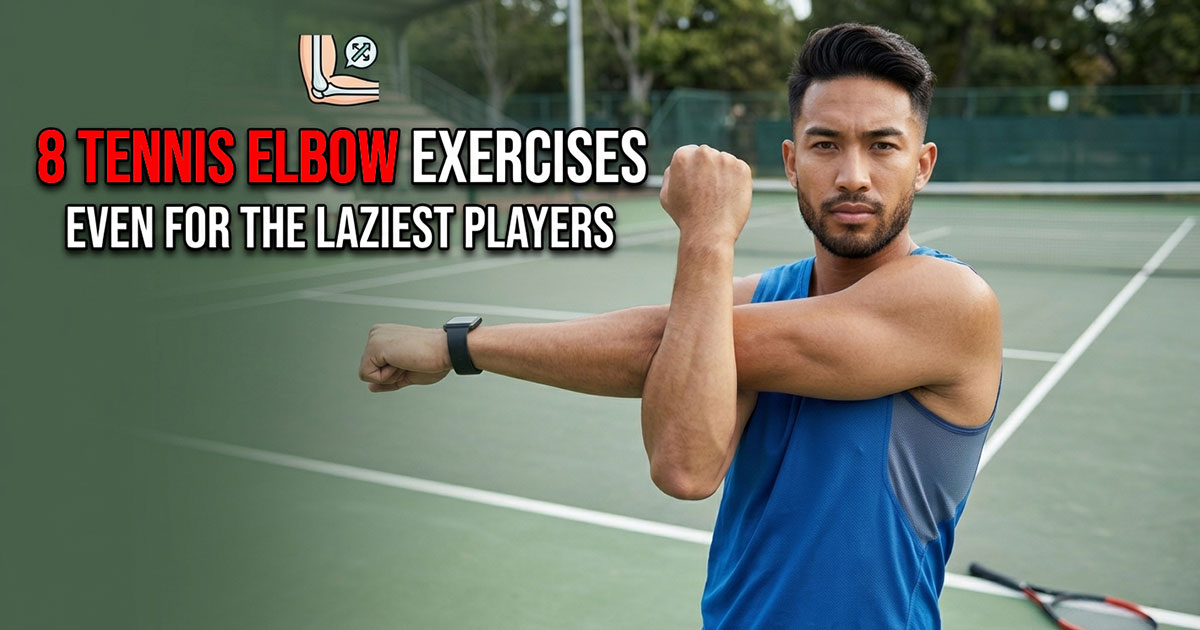
I’m the last person who should be writing about tennis elbow exercises.
Let me be honest with you upfront.
My idea of a workout routine is a morning walk, some stretching at my desk between work sessions, and the occasional half-hearted attempt at sit-ups that I abandon after three reps. I am not a gym person. I don’t follow training programs. I don’t own dumbbells.
And yet here I am, writing about exercises.
Here’s the thing though — that’s exactly why this might be the most useful article on this topic you’ll find today. Every other guide out there is written by a physical therapist, a certified trainer, or a content writer pretending to be one. They give you 12-week rehab programs with progressive overload charts and resistance band protocols that look great on paper and collect dust in real life.
This one is written by a recreational player who plays five mornings a week, got tennis elbow from a bad string job, and fixed it with two stretches he found on YouTube from a badminton player.
What you’ll find here are the simplest, most doable tennis elbow exercises I’ve come across — the ones that fit into real life, not a physical therapy schedule. Some I’ve done myself and can vouch for personally. Others come from sources I trust and recommend without hesitation.
No gym required. No special equipment. No excuses.
Well — almost no excuses. We’ll get to that.
Before You Start: What Tennis Elbow Recovery Actually Needs
Thirty seconds of context. I promise it’s worth it.
Tennis elbow is not a muscle problem. It’s your tendon — the bit that connects your forearm muscles to the outside of your elbow — that’s angry and inflamed.
And tendons? They’re drama queens when it comes to healing. Low blood supply. Slow recovery. Very particular about what they respond to.
Good news: what they respond to is simple. Two things: gentle stretching and gradual loading.
Stretch them. Gently, consistently, every day.
Load them gradually. Give them something to work against so they rebuild strength over time.
That’s it. No ice baths. No expensive gadgets. No 12-week rehab programs.
What doesn’t work — and I found this out the hard way — is slapping hot oil on it and hoping for the best. Also: complete rest. Sounds logical, feels great, but the moment you pick up a racket again the pain comes right back. Tendons need movement to heal. Just the right kind of movement.
Everything below is built around those two principles. Simple stretches. Simple strengthening. Nothing that requires a gym membership or more than ten minutes of your day.
Speaking of which — ten minutes. That’s all this takes.
Still think you’re too busy? You’re playing tennis five mornings a week. You have ten minutes.
The Stretches: Your Tennis Elbow Exercises Home Base
These are the moves that started it all for me.
I found them on YouTube late one night, elbow throbbing, scrolling through an endless parade of physios selling recovery programs. Then I stumbled on a video from a Vietnamese badminton player named Nguyễn Duy — not a doctor, not a trainer, just a guy who’d had tennis elbow so bad he couldn’t lift a cup of water.
Two stretches. That’s all he shared.
I tried them that night. I kept doing them every morning and evening. Slowly, stubbornly, my elbow came around.
If you want the full story, it’s over here → [How to Fix Tennis Elbow: What Actually Worked for Me at 47]
For now — here are the moves.
Stretch #1 — Wrist Flexor Stretch
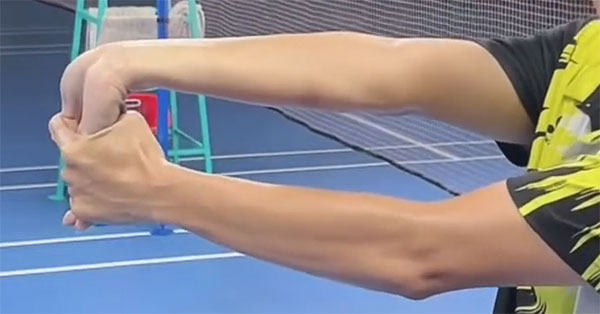
Extend your arm straight out in front of you, palm facing up. Use your other hand to gently pull your fingers and palm downward, toward the floor. You’ll feel a stretch running along the top of your forearm, right where the tendon sits.
Hold for 20 seconds. Release. Do it 3 times.
You’ll feel a mild sting at the tendon point. That’s normal. That’s exactly where you want to feel it. Don’t push through sharp pain — but don’t back off the moment it gets slightly uncomfortable either. Find the edge. Hold it.
Do this in the morning. Do it in the afternoon. Do it sitting at your desk right now if you want. No one will notice. No one will care. But your elbow will.
Stretch #2 — Wrist Extensor Stretch
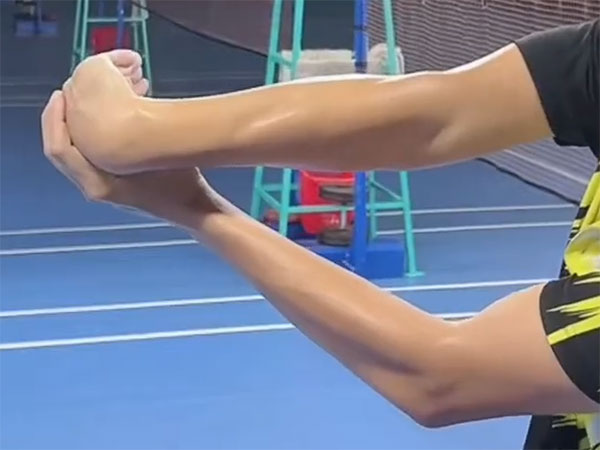
Same starting position — arm out straight. This time, rotate your wrist downward and outward, palm facing away from you, fingers pointing toward the floor. Use your other hand to gently push the back of your hand further into the stretch.
Hold for 20 seconds. Release. Do it 3 times.
Two stretches. Forty seconds each round. Three rounds a day if you can manage it — morning, afternoon, evening. If you only do it once, still do it. Something beats nothing, every single time.
Total time: about two minutes.
You can’t tell me you don’t have two minutes.
Stretch #3 — Fist Clench & Extend
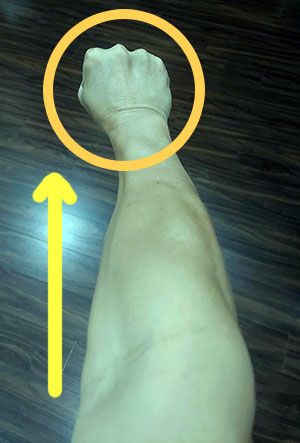
Make a tight fist. Extend your arm straight out in front of you. Hold the stretch for a few seconds, then release. Repeat.
That’s it. Genuinely.
Do this one anywhere — waiting for your coffee, sitting in traffic, watching the match highlights before bed. No setup, no equipment, no excuse whatsoever.
This one doesn’t look like much. But done consistently throughout the day, it keeps blood moving through the tendon and maintains mobility between your longer stretch sessions.
Think of it as the snack between meals. Small, easy, adds up.
The Strengthening Work: Teaching Your Tendon to Handle Load Again
Stretching gets you out of pain. Strengthening keeps you out of pain.
That’s the difference. And it’s an important one.
A lot of players stop at the stretches — pain goes away, they feel fine, they go back to playing hard five mornings a week, and three months later the elbow flares up again. The tendon never got strong enough to handle the load. It just got comfortable.
Don’t be that player.
The moves below are about rebuilding your tendon’s capacity — gradually giving it more to work against so it stops complaining every time you hit a backhand. None of them require a gym. Most require nothing more than a towel or a water bottle.
Let’s go.
Exercise #1 — Towel Wring
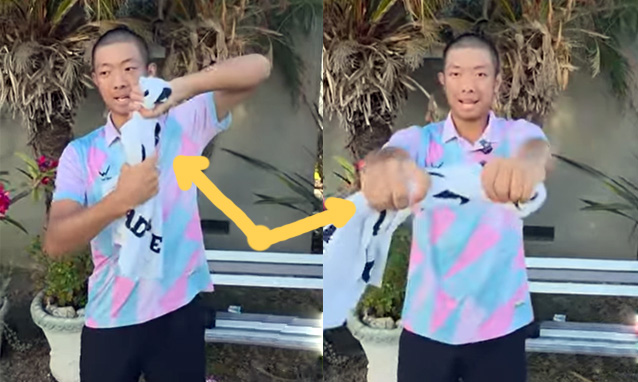
Grab a towel with both hands. Wring it — twist one direction, then the other, like you’re squeezing water out of wet laundry. Slow and controlled. Not aggressive.
That wringing motion works exactly the muscles and tendons involved in tennis elbow. It strengthens through the full range of motion, which is precisely what your tendon needs to rebuild load capacity.
Quang Duong — a Vietnamese-American professional pickleball player with a serious following — shared this one, and plenty of players have reported real results from it. Simple, effective, and oddly satisfying.
Do it 10 times in each direction. Once or twice a day.
And yes — if your household happens to involve hand-washing laundry, you now have a legitimate medical reason to do it the old-fashioned way. You’re welcome.
Exercise #2 — Eccentric Wrist Extension
This one has the most research behind it. Physical therapists recommend it consistently for lateral epicondylitis — it’s the closest thing to a universally agreed-upon tennis elbow exercise that exists.
Here’s how it works:
Rest your forearm on a table, palm facing down, wrist hanging off the edge. Hold something light in your hand — a water bottle, a can of soup, anything with a bit of weight. Lift your wrist up using your other hand, then slowly — and this is the key word, slowly — let the weight pull it back down. Three counts on the way down. Don’t rush it.
The slow lowering phase is where the magic happens. That’s the eccentric part. That’s what rebuilds tendon strength.
10 to 15 reps. Rest. Two more sets. Once a day.
If you want more resistance as you progress, a light resistance band works better than adding heavy weight — easier to control, gentler on the joint. Something like this works well → [affiliate link]
Exercise #3 — Forearm Supination & Pronation
Hold something light — same water bottle. Bend your elbow to 90 degrees. Slowly rotate your forearm so your palm faces up, then back down so it faces the floor. That’s one rep.
Up. Down. Slow. Controlled.
20 reps each side. Once a day.
This one targets the supinator muscle — a forearm muscle that’s almost always involved in tennis elbow but rarely gets addressed. Consider it the underrated player in your recovery lineup.
Exercise #4 — Ball Squeeze
Grab a tennis ball. Or a stress ball. Or a rolled-up sock. Squeeze it firmly, hold for a second, release slowly. 20 to 25 reps. Two or three times a day.
You can do this one anywhere. Watching TV. On a call. Sitting courtside waiting for your turn.
It looks like nothing. It adds up to something.
Still here? Good. That’s four strengthening exercises, none of which require leaving your house, joining a gym, or spending money on anything you don’t already own.
If you’re thinking “this seems too simple to actually work” — that’s the point. Simple done consistently beats complicated done occasionally. Every single time.
Now do the exercises.
Self-Massage: Two Minutes That Most Players Skip
This one doesn’t look like an exercise. That’s why most players skip it.
Don’t.
Your forearm muscles take a beating every session — gripping, swinging, absorbing vibration on every shot. By the time you walk off the court, they’re tight, tired, and pulling on that already-irritated tendon with every movement. A little manual attention goes a long way.
Here’s all you need to do:
Rest your forearm on your thigh, palm facing down. Use the thumb of your other hand to massage slowly along the outside of your forearm — from just below the elbow down toward the wrist. Firm pressure, slow strokes. You’ll find spots that are tighter than others. Spend a little extra time there.
Two minutes. That’s it.
Do it after you play. Do it at your desk while you’re reading something. Do it right now if your elbow’s been bothering you today.
No foam roller required — though if you want one, they work well for this too. A massage ball works even better for this — small enough to target the forearm precisely, easy to toss in your tennis bag.

The goal here isn’t deep tissue work. It’s just reducing tension in the muscles that are constantly pulling on your tendon. Less tension in the muscle means less stress on the attachment point. Less stress means faster recovery.
Simple cause and effect.
One more thing — this is also a good way to check in with your elbow regularly. If you’re massaging along the forearm and find a new spot that’s significantly more tender than usual, that’s your body flagging something. Pay attention. Ease off the intensity for a day or two. Don’t wait until it becomes a full flare-up before you respond.
Your elbow talks. It helps to listen.
Don’t Skip This: Warm-Up and Cool-Down for Tennis Elbow Prevention
I already covered the full warm-up routine in detail over here → [How to Fix Tennis Elbow: What Actually Worked for Me at 47]
But it’s worth saying again, because it’s that important.
Skipping your warm-up is how a lot of tennis elbows get started in the first place. Mine included. You show up, your friends are already rallying, the competitive itch kicks in, and suddenly the 10-minute warm-up becomes optional. Then rare. Then nonexistent.
Sound familiar? Be honest.
Quick warm-up reminder before you play:
Shadow swings first — forehand, backhand, volley, smash, 10 reps each, three rounds. Then short court rally inside the service boxes for five minutes. Then gradually move back and build up pace. Fifteen minutes total. Non-negotiable.
Now — the part most players completely forget: cooling down after you play.
You finish your last point, someone cracks a joke, you start packing up your bag, and you’re in the car ten minutes later with a hot, tight forearm and zero idea why your elbow keeps flaring up.
Sound familiar again?

Spend five minutes before you leave the court. Just five. Here’s what to do:
- Wrist Flexor Stretch — the one from Section 2. Both arms, not just the injured side. 20 seconds each.
- Wrist Extensor Stretch — same. Both arms. 20 seconds each.
- Shoulder cross-body stretch — pull one arm across your chest, hold 20 seconds. Switch sides. Your shoulder takes more load than you think during play.
- Tricep stretch — reach one arm overhead, bend at the elbow, use the other hand to gently push down. 20 seconds each side.
- Wrist circles — slow, full range, both directions, 10 reps each. Thirty seconds total.
Done. Five minutes. You’re loose, your tendons are happy, and you’re not storing up problems for tomorrow morning’s session.
Here’s the mindset shift that helped me: the cool-down is not optional extra credit. It’s the last set of the session. It counts. Treat it that way.
And if you’re the type who packs up and leaves the second the last point is done — you know who you are — ask yourself this: is saving five minutes now worth missing five weeks later?
Didn’t think so.
A Simple Weekly Routine for Recreational Players
Okay. You now have eight things to do for your elbow.
I know what you’re thinking. “This guy said no excuses and now he’s giving me eight exercises.”
Fair point. Let me simplify.
You don’t need to do everything every day. You need to do the right things at the right times — consistently, without overthinking it. Here’s how I’d break it down for a recreational player who’s on the court five mornings a week and has a real life the rest of the time:
Before you play — 2 minutes
Wrist Flexor Stretch + Wrist Extensor Stretch. Both arms. Three rounds each. Do this while your friends are arguing about who serves first. By the time they’ve sorted it out, you’re done.
During the day — whenever
Fist Clench & Extend. Ball Squeeze. Do these at your desk, on a call, watching TV, waiting for anything. No setup. No excuses. If you’re reading this right now and your elbow has been bothering you — put down your phone for thirty seconds and do ten reps of each. Go ahead. This article will still be here.
After you play — 5 minutes
Cool-down stretches from Section 5. Non-negotiable. Pack up your bag after, not before.
Once a day — 5 minutes
Eccentric Wrist Extension + Forearm Supination & Pronation + Self-Massage. Pick a consistent time — right after dinner, before bed, whenever works. The exact time doesn’t matter. Doing it at the same time every day does.
Once or twice a day — 1 minute
Towel Wring. Morning shower towel. Kitchen towel after washing up. Your tennis bag towel after a session. Opportunities are everywhere if you’re looking for them.
| When | What | Time |
|---|---|---|
| Before play | Stretches #1 + #2 | 2 min |
| During the day | Fist clench, ball squeeze | Anytime |
| After play | Cool-down routine | 5 min |
| Once daily | Eccentric extension + supination + massage | 5 min |
| Once or twice daily | Towel wring | 1 min |
Total committed time per day: about 12 minutes.
Twelve minutes to keep playing five mornings a week without your elbow shutting you down. Twelve minutes to avoid weeks on the sideline. Twelve minutes that most recreational players won’t bother with — which is exactly why most recreational players keep getting injured.
Don’t be most recreational players.
You’ve read this far. You clearly care enough to do something about it. Twelve minutes is not the obstacle. Deciding to start is.
So start today. Not tomorrow. Not after the next session. Today.
Exercises keep your recovery moving forward. But if you’re still on the court while you heal — and let’s be honest, most of us are — this guide is worth reading before your next session.
Consistency Beats Intensity — Every Single Time
Here’s the truth about tennis elbow recovery.
It’s not about finding the perfect exercise. It’s not about the most advanced rehab protocol or the most expensive brace or the fanciest resistance band on Amazon.
It’s about showing up for your elbow the same way you show up for your game — consistently, repeatedly, without making excuses.
Two minutes of stretching in the morning. Five minutes of cool-down after you play. A towel wring here, a ball squeeze there. None of it is hard. All of it adds up.
The players I know who beat tennis elbow for good didn’t do anything heroic. They just didn’t stop doing the small things. Day after day, session after session, until the tendon caught up and stopped complaining.
That’s the whole secret. Unglamorous as it sounds.
One last thing before you go.
If you’ve been doing these exercises consistently and the pain is still not shifting — or if it’s getting worse — don’t tough it out indefinitely. See a sports physio. Some cases need more than self-management, and there’s no shame in that. The goal is to keep playing for as long as possible. Sometimes that means asking for help.
Which brings me to the only piece of tennis advice I keep coming back to, no matter what:
“It doesn’t matter how well you play. What matters is how long you get to play.”
My coach said that to me years ago. I’ve forgotten it more times than I should have. But it always finds its way back.
Take care of your elbow. Take care of your game. They’re the same thing.
Further reading:
→ “How to Fix Tennis Elbow: What Actually Worked for Me at 47 (No Brace, No Doctor)“ — the full story behind how I fixed mine without a brace, including the exact YouTube video that started it all.
→ “Best Tennis Elbow Brace for Tennis Players (2026)“ — if you need support while you recover and want an honest recommendation from someone who’s actually on the court.
See you out there.
— Michael