
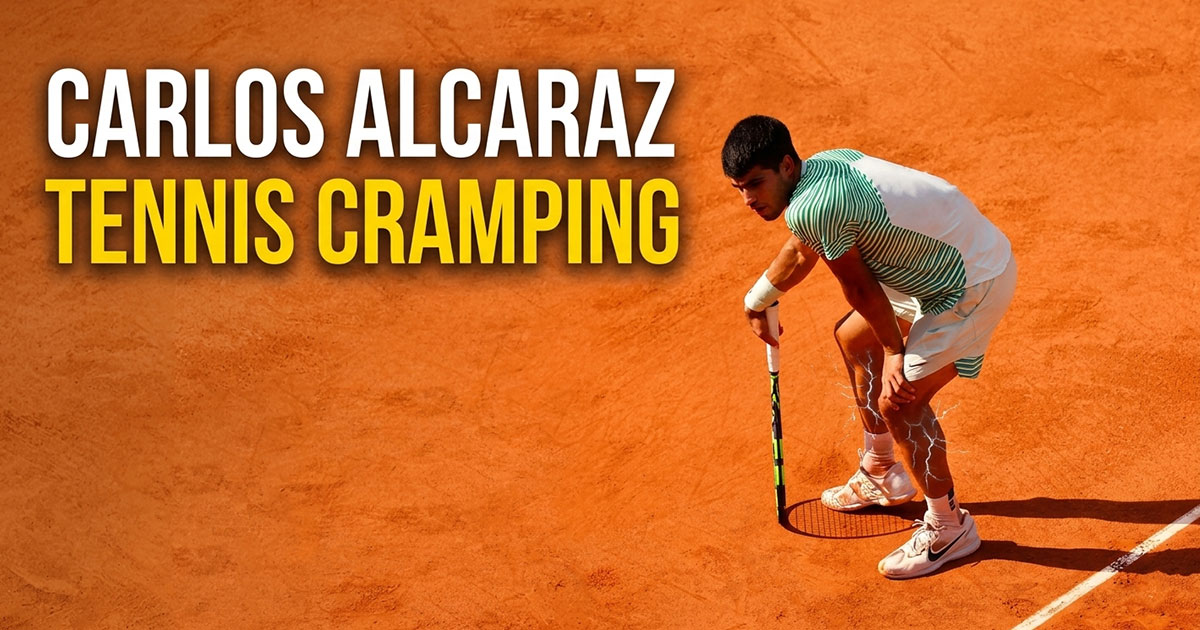
Tennis cramping doesn’t announce itself politely.
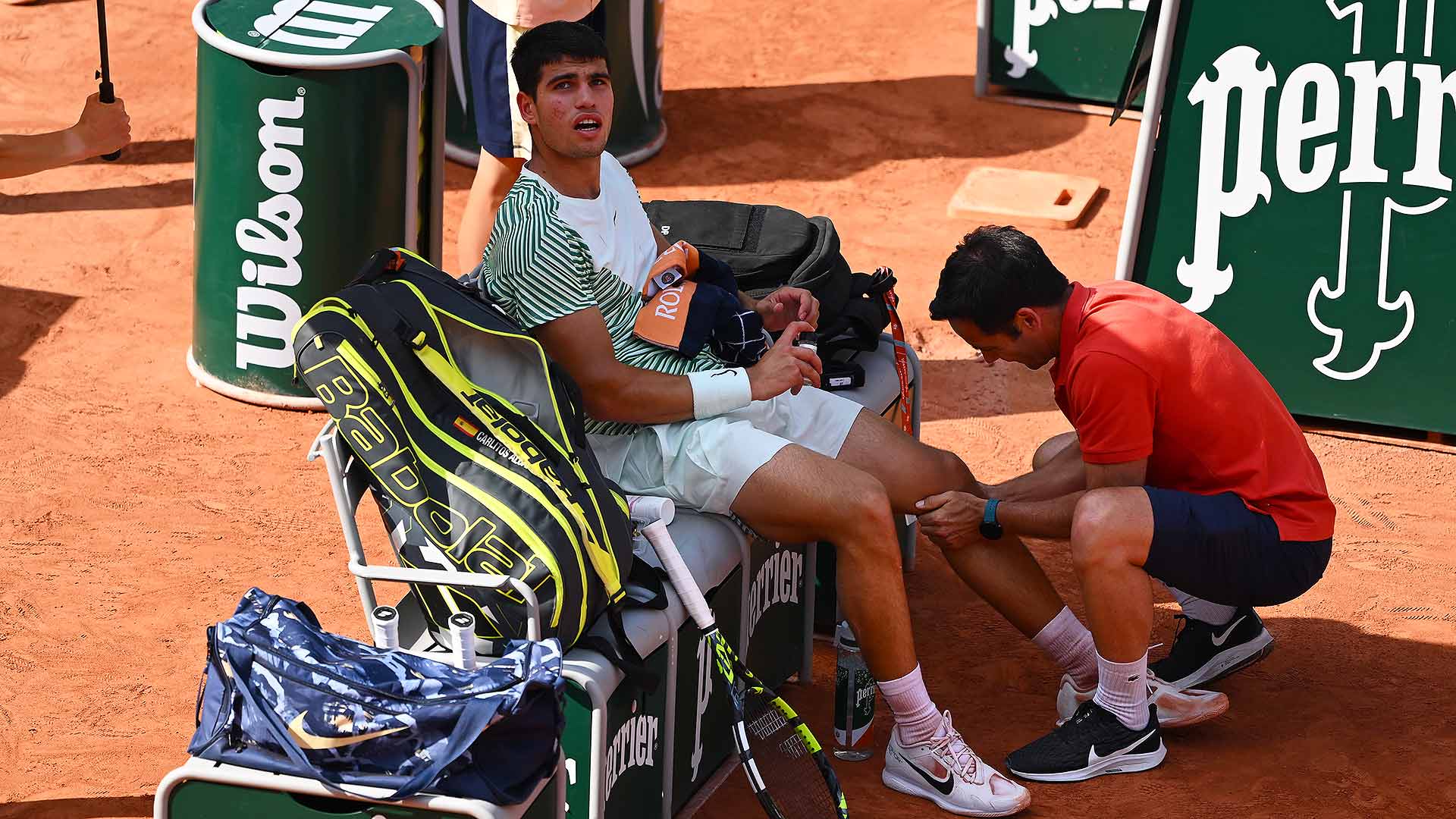
One second you’re watching Carlos Alcaraz do something so ridiculous that 15,000 people in Roland Garros lose their minds. The next second, he’s hobbling. That explosive first step — the one that makes him the most exciting player on the planet — is gone. His leg has locked up, right there in the middle of one of the greatest matches of his young career.
I was watching from home. And I remember thinking: how does that happen to a 20-year-old at peak physical condition?
It took me a few more years — and a few too many rec tournaments — to figure out the answer.
It’s Not About Fitness. It’s About the Situation.
Here’s the thing I’ve noticed playing rec tennis for years.
The guys who cramp at tournaments are not the unfit guys. They’re not the ones who skip practice or show up out of shape. They’re often the same players who show up five mornings a week, run every ball down, and never have a problem.
Until tournament day.
I’ve watched it happen at almost every rec tournament I’ve been part of. Always the same pattern. Always the later rounds. Always the guys who’ve been competing all day — grinding through match after match — and then somewhere in the second set of their fourth match, a calf locks up or a quad goes rigid and the whole thing unravels.
Tennis cramping in a regular Tuesday morning hit? Almost never. Tennis cramping at a one-day tournament? Nearly guaranteed for someone.
So what’s actually going on?
Why Tournaments Are a Perfect Storm
Playing tennis five days a week is something your body understands. It knows the pace. It knows roughly how long you’ll be out there. It’s adapted.
A rec tournament is something completely different — and your body hasn’t signed up for what you’re about to ask it to do.
Think about what actually happens on tournament day. You play two, three, sometimes four matches back to back with minimal rest between them. Adrenaline is running higher than any normal session — which means you’re moving faster, hitting harder, and pushing into corners you’d normally let go. You forget to eat because you’re focused on the next match. You drink water when you remember, which isn’t often enough. The sun is out. The court is hard. And the cumulative fatigue from match one is sitting in your legs by the time match three starts.
Cramping happens when three things collide at once: dehydration, electrolyte depletion, and muscle fatigue. A regular Tuesday morning might give you one of those, maybe two on a bad day. A tournament hands you all three simultaneously, with a side of competitive stress that makes everything worse.
Your body doesn’t cramp because you’re unfit. It cramps because you asked it to do something it wasn’t prepared for.
The Beer Question (Yes, We’re Going There)
Ask any group of rec players how to prevent tennis cramping and someone will mention beer.
I’ve heard it enough times that I had to look into it. And the honest answer is: it’s complicated.
Beer does contain sodium and carbohydrates — both of which help with electrolyte replenishment. So there’s a sliver of logic there. But alcohol is also a diuretic, meaning it actively pushes fluid out of your body. Which is the opposite of what you need when you’re already dehydrated from three sets in the sun.
My best guess for why people swear by it: they’re sitting down long enough to drink it, they’re probably drinking water alongside it, and the mental relaxation of cracking one open after a tough match doesn’t hurt. The rest might be placebo.
I’m not here to tell anyone what to do before a match. But if the beer seems to be working — it’s probably not the beer doing the heavy lifting.
What Actually Works: Before, During, and Between Matches
The good news is that tennis cramping is largely preventable. The bad news is that you have to start the prevention before you even get to the tournament.
The day before
This is where most rec players lose before they’ve started. Hydration the morning of tournament day is too late — your body needs 24 hours to fully load up. Drink more water than usual the day before. Eat a normal, solid meal the night before with carbohydrates. Sleep. These sound boring because they are, but they work.
Morning of
Eat breakfast. A real one. Your body is going to burn through fuel faster than you think, and starting on empty is asking for trouble by match two. Bring electrolytes with you — a sports drink, electrolyte tablets, even a banana and some salted nuts. Don’t rely on whatever is available courtside.
Between matches
This is the most overlooked window. You finish a match, you’re relieved, you sit down, you check your phone. Meanwhile your body is trying to recover for the next one.
Use the gap deliberately. Rehydrate with something that has electrolytes in it, not just water. Eat something small — a banana, an energy bar, anything. Stretch your calves and quads for a few minutes. Let your heart rate come down properly before you warm up for the next match.
When you feel the early signs
That tightening sensation in your calf or quad — the one that isn’t quite a cramp yet but is clearly a warning — is the moment that matters most. Don’t ignore it and hope it goes away.
Stop. Stretch it gently. Drink something with electrolytes immediately. If you need a moment, take it. One point is not worth what happens if you push through and the full cramp locks in.
It’s the same principle I wrote about in the ankle brace piece — the warning sign is the warning. Respect it the first time and you stay on the court. Ignore it and your tournament might end right there.
Back to Alcaraz
What happened to Alcaraz against Djokovic that day at Roland Garros wasn’t a fitness failure. He was playing some of the most physically demanding tennis of his life, on one of the biggest stages of his career, against the most mentally formidable opponent the sport has ever produced.
His body simply couldn’t keep up with what his mind and his adrenaline were demanding from it.
For us rec players, the stakes are lower. The tennis is slower. But the physiology is identical. You push harder at tournaments. You forget to eat and drink properly because you’re focused on competing. Your muscles accumulate fatigue across matches in a way they never do on a regular morning hit.
Tennis cramping doesn’t mean you’re out of shape. It means you underprepared for a specific situation — and now you know how to fix that.
You trained all year for this tournament. Don’t let a cramp be the reason you remember it.
Have you cramped at a tournament? What worked — or didn’t? Tell me in the comments. And yes, the beer theory is absolutely open for debate.
— Michael
Related reading: → Tennis Elbow: The Complete Guide for Tennis Players → Best Ankle Brace for Tennis Players: A Rec Player’s Honest Guide → Alcaraz’s Wrist, Del Potro’s Ghost, and Why I Taped My Elbow and Played Anyway